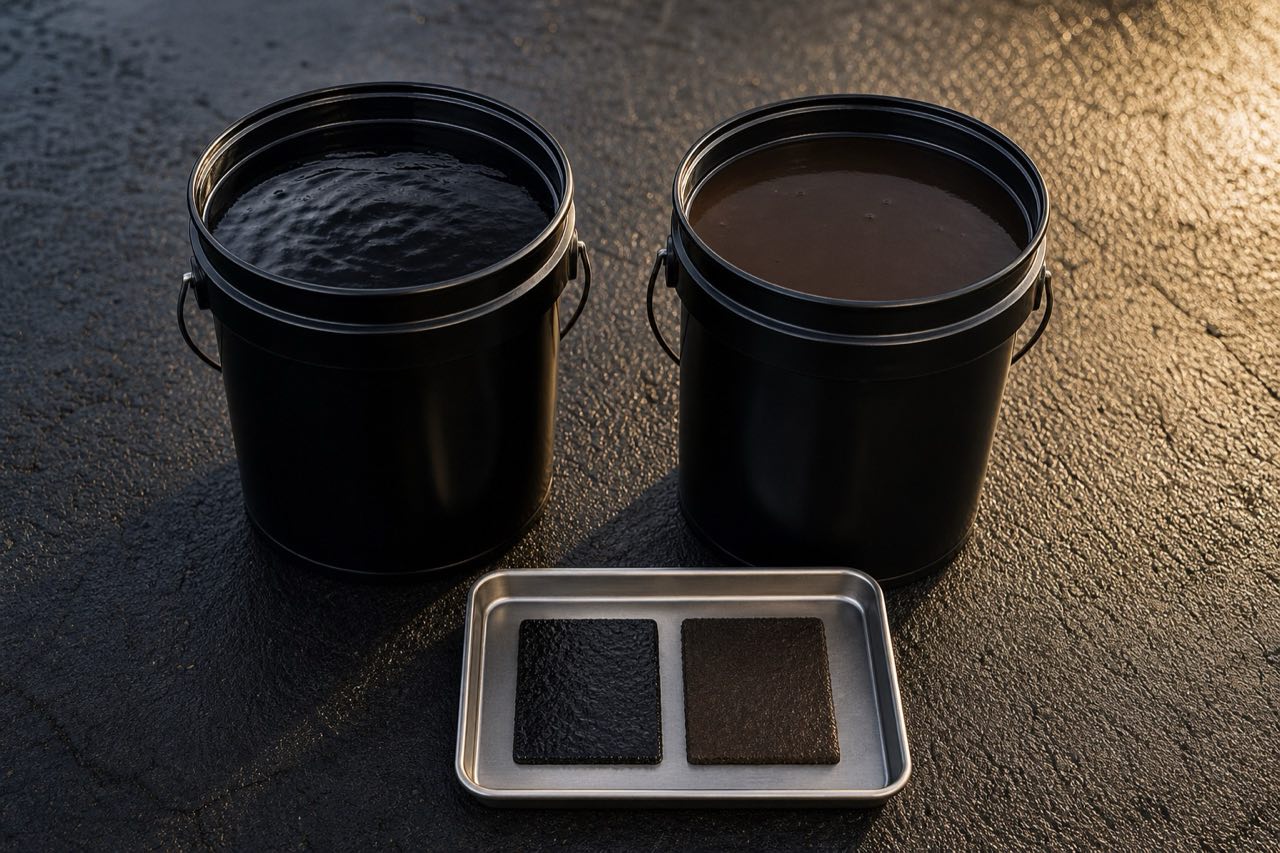
Where is coal-tar sealcoat banned?
The July 2026 fact pack identifies statewide bans in Washington, Minnesota, Maine, New York, Maryland, and Virginia, plus the District of Columbia; Canada has a national restriction. Local bans extend beyond those states. Rules and effective dates can change, so confirm current law for the project jurisdiction instead of treating a list as permanent legal advice.
North Carolina has no statewide ban in the fact pack. Charlotte, Matthews, and Mecklenburg County are listed as local bans. High Point and the 5 surrounding service cities were not verified as having municipal bans, so we do not claim one. Absence of a verified ban does not answer the material preference or environmental question.
Why do we prefer asphalt emulsion?
The USGS PAH evidence creates a strong reason to avoid coal tar when a workable lower-PAH pavement-sealer family exists. Asphalt emulsion also avoids presenting a legal product as harmless merely because North Carolina lacks a statewide ban. The preference is environmental and health-risk reduction, not a guarantee that every emulsion product or application will perform equally.
The provider still must confirm the actual product in writing. Ask for the manufacturer, product data sheet, safety data sheet, asphalt-emulsion identification, solids or dilution instructions, sand or additive system, coverage rate, pavement limits, and cure. Do not accept coal-tar-free as a substitute for naming what is being applied.
Is asphalt emulsion always better on the pavement?
No universal ranking covers every climate, traffic, fuel exposure, existing coating, and product formulation. Coal-tar advocates often cite fuel and chemical resistance; emulsion systems vary in formulation and additives. Existing coal-tar layers can create compatibility questions. The surface condition and manufacturer instructions need to be part of the selection rather than a one-word material rule.
Our position is narrower: the PAH difference deserves decisive weight, and the vendor should prove that the lower-PAH proposed system fits the existing pavement. A test area can help when prior chemistry is unknown. Preparation, dry film, coverage, weather, and traffic remain as important as the label on the pail.
Is spray or brush and squeegee better?
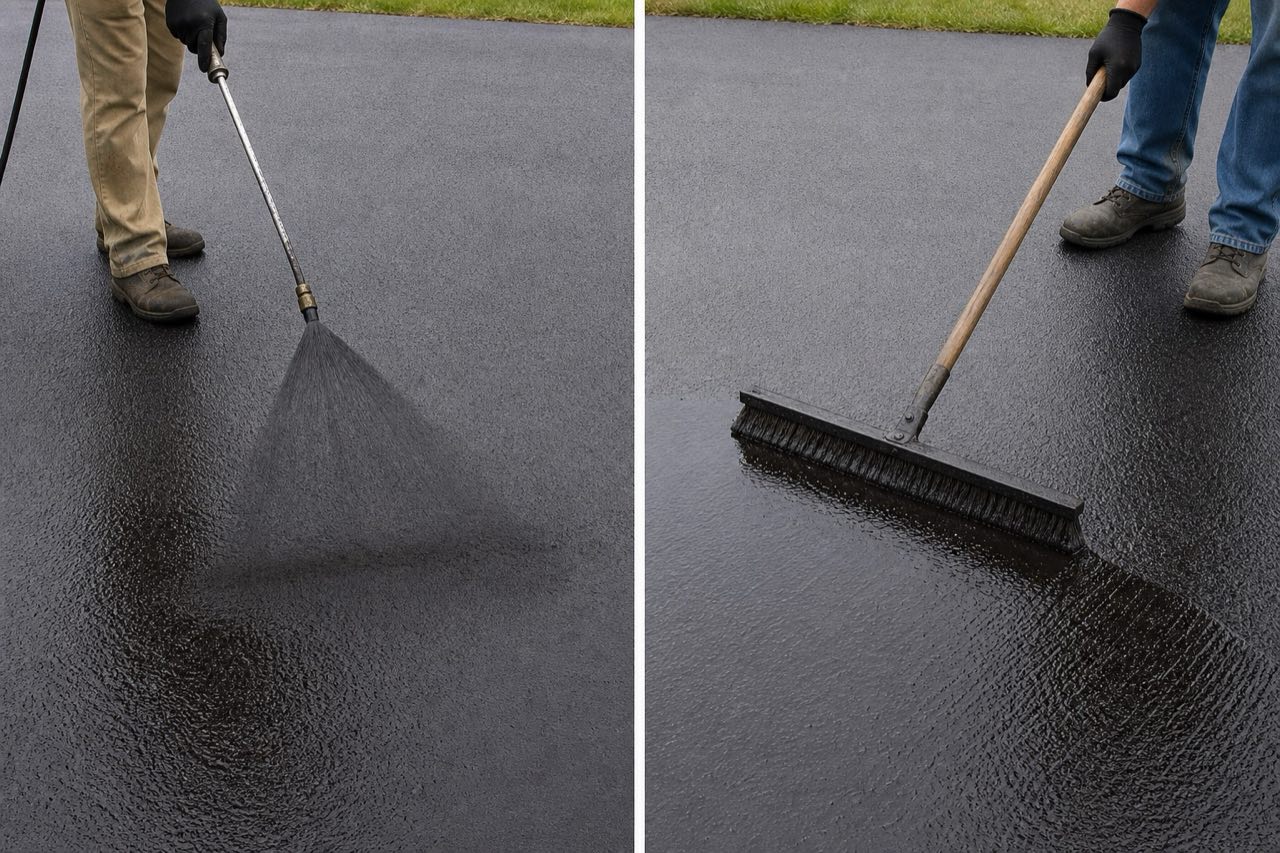
Spray can apply an even controlled fan efficiently and reach textured areas. A brush or squeegee can work material across rough aggregate, edges, and hand zones. Neither method guarantees thickness. A spray system can be calibrated correctly or under-applied; a squeegee can place a substantial film or push an over-diluted mix thin. Coverage rate and dry material matter.
Ask why the method fits the surface, how adjacent property is protected, how gallons relate to measured square feet, where hand work occurs, and whether 2 coats use different directions after proper drying. In commercial work, some specifications use a squeegee coat followed by spray. The product manufacturer and written system should support the sequence.
What does 1 coat versus 2 coats really mean?
A coat is a complete application at a defined coverage rate, followed by the required dry or recoat interval. Two passes in different directions while the same wet film is being placed are not necessarily 2 coats. A second coat can improve uniform coverage and traffic durability on suitable surfaces, but it doubles neither life nor structural capacity.
Request measured area, gallons before any allowed dilution, final mix, rate per coat, application method, recoat time, and total traffic closure. More coats over dirty, damp, too-new, or failed asphalt do not solve the underlying problem. Excessive repeated buildup can create slipperiness, checking, or compatibility issues.
What should you ask before authorizing a material?
Ask: Is it coal tar, asphalt emulsion, acrylic, or another chemistry? What exact product and manufacturer? What does the safety data sheet say? Is the product allowed at this address? What existing coating is present? How is the surface tested or prepared? What dilution is allowed? How many gallons cover the measured area? What weather and cure rules apply?
Then connect material to price. Published July 2026 material-only comparisons put asphalt emulsion around $0.08–$0.10 per square foot and some latex or acrylic systems around $0.20–$0.25, while broader chemistry ranges span about $0.06–$0.38. Those are national material estimates, not installed High Point prices. The vendor confirms the actual named system and written total.